
Supply chain transparency is the key to continuous improvement at VDM Metals
More than a hundred alloys. Small, highly specific batches. Production stages split across internal plants and external partners. VDM Metals moved this network from reactive to proactive planning, and made transparency the engine of continuous improvement.
A Catch-22 on the plant floor
Global competition pushed VDM Metals to cut costs, cut inventory, and become more efficient. Customers pushed for shorter lead times and better delivery performance. The two demands pulled in opposite directions.
VDM Metals is a global producer of high-performance alloys, including nickel, cobalt, and zirconium alloys, serving the chemical process industry, oil and gas, aerospace, electronics, automotive, and energy. In Germany it runs an upstream melting shop in Unna and four downstream facilities in North Rhine-Westphalia. In the United States it operates an upstream facility in Florham Park, New Jersey, and a downstream plant in Reno, Nevada. In February 2026 the company broke ground on a new facility in Unna for high-purity metal powders for additive manufacturing.
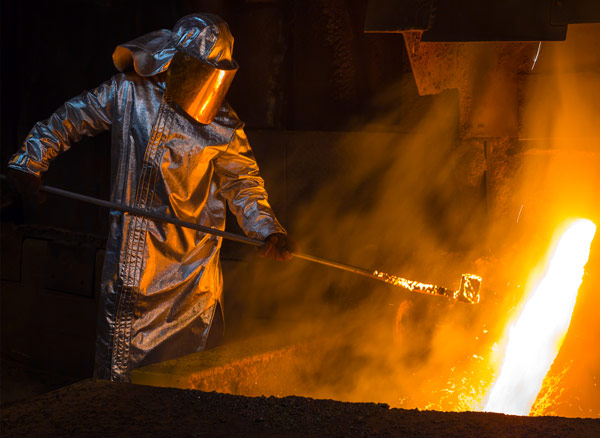
Processes are extremely complex. Numerous discrete production stages, more than a hundred different alloys, relatively small and highly specific batches, and some stages carried out by external partners.
Production planning, production execution, and customer requirements are closely interrelated, Marcell Sehner, Senior Vice President of Digital Transformation and Services, explains, which is why a new system alone would not have been enough. VDM Metals also identified the need to reconfigure the organization "from a functional to a process-oriented one." Changing the software without changing the structure would have moved the problem, not solved it.
Where metals supply chain planning was breaking
A project modeled the entire value chain in Unison Planning™, including every aspect of production. A bottleneck-oriented finite capacity analysis surfaced what spreadsheets had hidden: where inventory rose unintentionally, which machines would run short of material, and where production stages could be brought into better alignment.
For Michael Schickentanz, Head of Operations Planning and Master Data Management, this was the turn.
One of the biggest gaps sat at the front of the process. Before, lead times were estimated from past experience. Now, Schickentanz says, VDM Metals can "base delivery date calculations, for inquiries as well as orders, on a transparent material and capacity check."
"For the first time, we could identify where inventory in production would rise unintentionally due to an imbalance between order backlog and plant performance. We could also predict which machines might encounter material shortages. This is how we managed to cut overall lead times and reduce our work-in-process."
Michael Schickentanz, Head of Operations Planning and Master Data Management
Some planners were skeptical about the new way of working. Transparency is what turned them. It is natural to resist change, Schickentanz notes, but the organization can now see the improvement rather than be told about it.
"Using the planning system is like holding up a mirror. It accurately reflects our planning decisions, the successful ones and the less successful ones."
Marcell Sehner, Senior Vice President of Digital Transformation and Services
Planning as a mirror
Confidence in the process grew as the results came in, backed by consistent support from senior management. Strong project teams of highly skilled people were assembled across the organization. An in-house center of competence for sales, supply chain management, and support solutions, plus a reliable data management program, were equally indispensable.
From detailed scheduling to sales and operations planning
Detailed production planning solved the near horizon. It did not answer what to commit to next quarter. VDM Metals extended into forecasting and sales and operations planning (S&OP) to connect the mid-term view to the plants already running on Unison Planning™. Budget forecasting and rolling monthly forecasting went live in under six months. S&OP followed six months later.
The resistance was not technical. Schickentanz won over the process owner by demonstrating the added value of advanced forecasting features: "comprehensive statistics, collaborative loops, graphical visualization, and customizable reporting."
S&OP in the metals industry
)

Automotive and aerospace, planned differently
Automotive is relatively predictable, with a high degree of standardization. Aerospace runs on framework agreements and needs far more planning detail. Unison Planning™, in Sehner's words, "allows us to take a different approach for these customer groups." One platform, two approaches, no compromise between them.
What's live
Unison Planning™ was introduced at VDM Metals at its plants in Germany, as well as those in the United States. The features implemented include:
- Melting shop scheduling
- Internal upstream and subcontractor planning
- Downstream planning, including campaign planning and scrap returns
- Inquiries and orders on a capable-to-promise (CTP) system
- Budget forecasting and rolling forecasting
- Sales and operations planning (S&OP)
- Detailed scheduling for the downstream plants
Next: the new powder production facility in Unna, where VDM Metals broke ground in February 2026 on high-purity metal powders for additive manufacturing, will be planned in Unison Planning™.
About VDM Metals
VDM Metals develops and manufactures nickel, cobalt, and zirconium alloys as well as high-alloy special stainless steels. Since 1930, the company has supplied sheet metal, strips, rods, wire, and welding consumables to customers in the chemical process industry, plant construction, power generation, oil and gas, electrical engineering, and electronics, as well as automotive and aerospace. Worldwide, VDM Metals employs more than 2,000 people.