
AstraZeneca’s journey to decision-centric autonomous planning
May 19
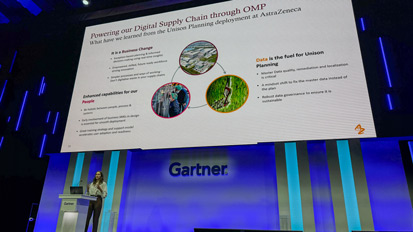 When Diane Gorman, Network Supply Planner at AstraZeneca, took the stage at the Gartner Supply Chain Symposium/Xpo™, she shared how the pharmaceutical multinational set out to fundamentally rethink how planning decisions are made, connected, and executed.
Powered by OMP’s Unison Planning™, AstraZeneca is building a more integrated, capacity-aware planning environment: one that enables faster, more confident decisions and lays the foundation for autonomous, AI-driven decision-making.
Planning in a world of growing complexity
As AstraZeneca's portfolio and global footprint expanded, the planning environment struggled to keep pace. Disconnected processes, spreadsheet-based workflows, and limited cross-functional visibility meant planners were spending more time reconciling information than making decisions. Constraints were hard to manage. Trade-offs were harder to align on. And when disruption hit, response times reflected the fragmentation underneath.
The ambition wasn't to patch the existing approach. It was to replace it entirely: one integrated plan, one source of truth, and a planning environment capable of supporting the next phase of autonomous, AI-enabled decision-making.
Three pillars driving AstraZeneca's transformation
1. From fragmented processes to a single, synchronized plan.
AstraZeneca replaced siloed, spreadsheet-heavy workflows with a single, capacity-constrained network plan powered by Unison Planning™. Demand, supply, and constraints are now in one unified view, giving everyone the same picture and the ability to act on it. The shift is structural. Instead of managing individual plans, they're now orchestrating decisions across the entire network.

2. AI takes on the planning load so planners can focus on what matters.
Unison Planning's AI-powered solvers handle the heavy lifting: embedding constraints, optimizing flows, and improving plan quality. AstraZeneca's planners can now focus on higher-value work:
- Running scenarios
- Managing exceptions
- Making informed, high-impact decisions.
The result is higher-quality plans, a faster, more agile response to change and a planning function that scales with the business.
3. Transformation is won or lost on adoption.
AstraZeneca was deliberate about this: the technology was only part of the story. Sustainable change required strong user enablement, high-quality master data, and a genuine mindset shift toward trusting AI recommendations and fixing root causes. That behavioral change, Diane emphasized, is what unlocks the full potential of autonomous planning.
Results that validate the approach
By synchronizing planning and embedding decision intelligence across the network, AstraZeneca is already delivering significant outcomes:
- Enhanced supply reliability and service levels
- Inventory reduction
- Productivity savings
These results demonstrate how decision-centric planning can simultaneously improve service, reduce cost, and increase resilience.

“Moving to a synchronized, decision-centric planning environment isn't just a technology upgrade; it's a fundamental change in how we make decisions at scale.”— Diane Gorman, Network Supply Planner, AstraZeneca
A foundation for autonomous planning
AstraZeneca's story isn't finished. With the foundation now in place, synchronized decisions, embedded AI, and a planning culture that trusts the system, the company is scaling toward fully autonomous planning. The goal isn't a better version of how things worked before. It's a supply chain that decides at the speed at which the world moves.