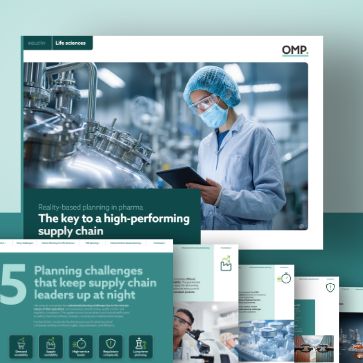
Why pharma schedules fail before lunch
Build schedules that hold when reality changes.
eBook
Why do pharma production schedules fail?
The Friday schedule looks solid. By Monday lunchtime, a component has run out mid-campaign, a line is idle, and the plan is being rebuilt by hand. It happens because most pharma schedules are built in Excel on assumptions, not operational facts, so real constraints like inventory, upstream dependencies, labor capacity, changeovers, and shelf life are missed until they break something.
And because API, bulk, and packaging are tightly coupled, one small miss cascades into lost throughput, missed orders, and catch-up shifts. Left unaddressed, that fragility quietly costs you throughput, service, and working capital, week after week.

eBook
Reality-based scheduling: a plan that holds
eBook
There is a different approach: reality-based scheduling. Instead of building a plan on assumptions and hoping it survives contact with the shop floor, the schedule is built on a digital twin of the plant, grounded in what is actually true, real capacity, materials, labor, and constraints. When planning and scheduling run on one model, a change on either side updates the other in real time, so the schedule stays feasible as conditions change instead of drifting out of date. Leading life sciences manufacturers are already scheduling this way across API, batch, and finished goods, for both small and large molecules, and doing it at execution level.
What's inside the e-book
- Why pharma schedules built on assumptions fail on the shop floor, and what it costs in throughput, service, and working capital
- How reality-based scheduling grounds pharma production plans in operational facts, down to day-to-day variability
- How planning and scheduling on one model keep the plan feasible as conditions change
- How to recover when the unavoidable happens: a failed batch, a rejected input, an upstream outage
- How life sciences manufacturers schedule across API, batch, and finished goods, for small and large molecules
Proven in life sciences manufacturing
A global pharmaceutical manufacturer moved scheduling off spreadsheets and onto an operational digital twin, and now holds higher service levels while carrying less inventory.
How Unison Planning for Life Sciences works
This e-book shows how OMP's Unison Planning™ for Life Sciences builds the schedule on a digital twin of the plant. Planning and scheduling run on one model, so a change on either side updates the other in real time, and the schedule stays feasible as conditions shift.