
OMP deepens its presence in Japan as demand for AI-enabled, integrated supply chain planning accelerates
March 31
Inspiration Series Tokyo | Japanese market | Local expansion | Event takeaways
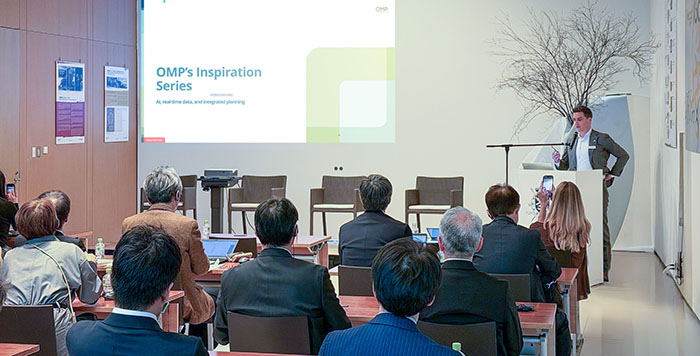
OMP is expanding its presence in Japan as companies across life sciences, consumer goods, and chemicals accelerate their investment in AI-enabled, decision-centric planning. Following a successful Inspiration Series event in Tokyo, OMP is deepening local partnerships and growing its team to support Japan's digital supply chain ambitions.
Inspiration Series Tokyo highlights industry momentum
OMP's recent Inspiration Series event in Tokyo brought together senior executives from leading companies across Japan's most active supply chain industries. Sessions focused on how AI, real-time data, and integrated planning are reshaping operational performance, with practical discussions on governance, cross-functional collaboration, and the role of always-on intelligence in faster decision-making.
“Always-on intelligence is reshaping how companies make decisions.”
Attendees included Shiseido, AstraZeneca, UCB, GSK, Bushu Pharma, Bayer, Dow, and Bridgestone, joined by partners EY, Deloitte, and Flanders Investment and Trade.

In his keynote, Haruki Onodera, Head of Global Supply Chain Transformation at Shiseido, outlined the company's approach to unifying its global supply network: “We aim to operate as one integrated global supply chain supported by best-in-class planning capabilities that strengthen agility and quality. Our focus is on optimized logistics, consistent ways of working, and full end-to-end visibility across the network.”
Why Japan is a priority market
Japan is a major global export hub, which means companies are directly exposed to geopolitical tensions, tariffs, and trade disruptions. at the same time, domestic pressures are intensifying: life sciences companies face a price-constrained, highly regulated home market alongside growing global expansion demands, while consumer goods companies are contending with faster-changing demand patterns, shorter product lifecycles, and increasing inventory complexity.
 Across industries, the common thread is a need for planning that responds to real-world signals rather than fixed cycles. Companies are investing in connected data, end-to-end visibility, and decision-making models that align supply, demand, finance, and commercial functions around a single, shared view of operations.
“Japan's role as a global export hub means disruptions are felt quickly and directly.”
Expanding OMP's local team in Japan
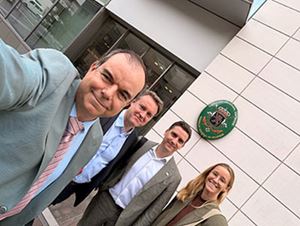 OMP is expanding its local team in Japan with new roles covering industry-specific sales, delivery alignment, and long-term customer partnerships. Additional hiring is planned for 2026 to further strengthen OMP's ability to support Japanese companies across life sciences, consumer goods, and chemicals.
“Japan’s industries are entering a pivotal moment where precision, resilience, and AI‑enabled decision making are becoming essential,” says Philip Vervloesem, Chief Commercial and Markets Officer at OMP. “The energy and engagement we are seeing confirm Japan’s readiness to lead in next‑generation planning, and OMP is committed to investing locally to support that journey.”
“Calendar-based planning cycles are being replaced by event-driven models that respond to real signals.”
8 takeaways from the event
- Disruption-exposed: As a major global export hub, Japan feels the impact of geopolitical tensions, tariffs, and trade disruptions quickly and directly.
- Innovation cycle: Japan is investing heavily in AI, automation, and advanced planning capabilities to build faster, more resilient operations.
- Event-driven planning: Calendar-based planning cycles are being replaced by models that trigger workflows based on real signals, supported by continuous intelligence.
- End-to-end visibility: Unified planning across supply, demand, regulatory, finance, and commercial functions improves both speed and quality of decisions.
- Dual pressure in life sciences: A constrained domestic market combined with global expansion demands strong governance, quality master data, and robust scenario planning.
- Shifting demand in consumer goods: Smaller formats, shorter lifecycles, and social-driven spikes are increasing pressure on inventory management and short-term demand sensing.
- Governance matters: Clear accountability and cross-functional collaboration, including with government bodies, consistently determine whether transformations succeed.
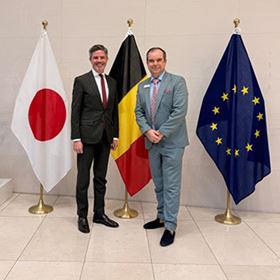
- Belgium-Japan ties: A strong bilateral relationship in pharma and chemicals provides a natural foundation for ongoing innovation and supply chain cooperation.
Learn more
Reality-based supply chain planning in pharma
This e-book shows how reality-based planning helps pharma companies stay agile, compliant, and efficient without sacrificing patient supply. Available in Japanese.
Making AI work for you: from explainable to agentic
This guide shows how decision-centric planning and agentic AI help organizations adapt continuously and act with confidence.
Get in touch
Have a media question or want to learn more about our solutions? Use our contact page to reach the right team.