Without our software, half of the factories in the world would slow down or even stop
December 6, 2025
Double interview with Paul Vanvuchelen and Anita Van Looveren. Translated from De Tijd (in Dutch by Tom Michielsen).
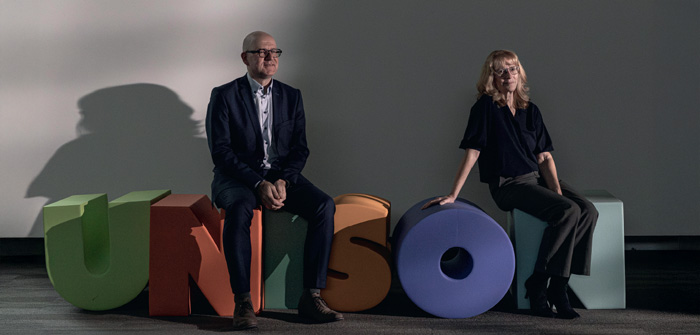
© SISKA VANDECASTEELE
DE TIJD, Saturday, December 6, 2025 - The Antwerp-based IT company OMP is turning 40, yet it has stayed under the radar all these years. Still, the planning software of this global player is indispensable in preventing the world’s largest manufacturing companies from descending into complete chaos. CEO Paul Vanvuchelen and Co-founder and Chair of the Board Anita Van Looveren see many more years of growth ahead for OMP.
Selling trust to organizations full of uncertainty
December 1985. At a desk in a villa in Brasschaat, a software engineer and an economist are working on a pressing question from a steel-processing company. How do you cut a sheet of steel in the optimal way with as little material loss and machine downtime as possible? The software engineer was the then 39-year-old professor Georges Schepens, driven to use mathematics to optimize industrial processes. The economist was recent graduate Anita Van Looveren, a mathematics expert specializing in quantitative econometrics. She became the first consultant Schepens hired in his academic spin-off, which he named Operations Management Partners (OMP).
Forty years and many hundreds of such assignments later, Van Looveren, who served as OMP’s CEO until the end of last year, is now chairwoman of the board. Paul Vanvuchelen, who joined in 2012 from stainless steel producer Aperam, took over as CEO. The now 79-year-old emeritus professor Schepens is still a shareholder and board member.
Over all those years, the company has grown into a global player in business-critical software for planning supply chains, production and distribution for the largest companies in chemicals, life sciences, metals, consumer goods (food and hygiene), plastics, paper and packaging. In each of these core industries, the company, which generates 250 million euros in revenue and employs 1,400 people, counts the top three multinationals among its more than 200 customers. These range from BASF and AkzoNobel, AstraZeneca and Johnson & Johnson to ArcelorMittal and Michelin, and from Nestlé to Procter & Gamble.
Small and humble
Van Looveren looks back with a mix of nostalgia and enthusiasm at the early years in the Brasschaat (Belgium) villa. “It was all so small and makeshift,” she laughs. “Georges and Bart (De Decker, the third colleague from the early days) each worked in a bedroom, I worked in the bathroom, our living room was the meeting room and the kitchen was the reception area. Because only ten to twenty people could work in such a villa, a few years later we took over the villa next door and also rented the one across the street. A classy version of the entrepreneurs’ garage.”
In time, when the company had already existed for more than fifteen years, about one hundred people were spread across five villas, plus several dozen in offices in the United States, France and the Netherlands. “That is when we decided to construct a new building and move.”
That long garage period says something about the down-to-earth philosophy the company still upholds today. It also explains why OMP remained a well-hidden gem in an industrial zone in Wommelgem (Belgium). The solutions it delivered quickly went far beyond cutting steel sheets optimally for Aperam. “I still signed that contract in Anita’s bathroom,” Vanvuchelen laughs.
"In the early days, my colleagues each had their desk in one of the villa’s bedrooms, and I worked in the bathroom. Our living room was the meeting room and the kitchen was the reception area. A classy version of the entrepreneurs’ garage, you might say.”
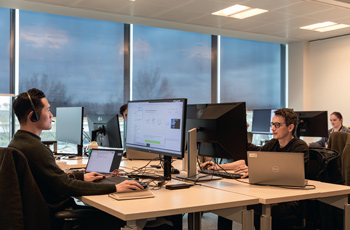
“The more variables you add, the more complex it becomes,” Vanvuchelen says. “Steel coils can have different alloys, widths or thicknesses and be used for multiple orders at the same time. Depending on that, for example, they need to be cut on different machines, and you quickly arrive at thousands of possible combinations. Our mathematical models help choose the best solution.”
So OMP was presented with increasingly complex questions that in the early 1990s shifted toward managing the entire supply chain of a company. For animal feed producer Versele Laga, it built a module to determine the ideal mix of raw materials, taking into account customer preferences and raw material prices. For Alcatel Bell, it developed software to assemble the first telephone switches for which all components were in stock at a given moment. For Tiense Suiker, it calculated which variety of beets should be processed in which factories to make a given type of sugar.
Textbook example
All in all, that was still small beer compared with the web of data and business-critical processes that OMP manages today with its Unison Planning™ platform. “For relatively simple questions with a limited set of variables, like at the time at Alcatel, Tiense Suiker or Versele Laga, you have at most a million possible outcomes,” Van Looveren says.
"You can still get through that with some solid Excel sheets, as was done until then. But if you have to make such plans with thousands of parameters, and not only in production but also at all the steps before and after it, from the supply of raw materials to the point of sale, you arrive at an almost infinite number of possible combinations. As a human you can never oversee, let alone interpret or manage that. Our software can.”
This planning software should not be confused with ERP packages such as those from SAP, which bring together data from all business departments in a central database. OMP’s platform works not only at the operational level of a single factory in minutes, days and weeks, but also at the tactical level of supply, production and logistics over several months and at the strategic layer, which includes major investment decisions.
 The story of OMP is a textbook example of how important the manufacturing industry is, and continues to be, for the development of a healthy service economy. OMP flourished in the slipstream of the typically Belgian industries built around chemicals, steel, paper, glass, pharmaceuticals, food and so on.
Vanvuchelen draws that growth on a sheet of paper as a steadily rising curved line, in other words exponential. “From the very beginning we have grown every year by an average of 15 percent, without any interruption. Not even the financial crisis in 2008 or the COVID-19 pandemic in 2020, when we mistakenly thought we would finally get a moment of rest, could slow that exponential growth. When times are good, companies need our software to maximize their revenue. When times are difficult, they need it to keep their costs under control or to redesign their production and logistics.”
In the first decade of the century, one global player after another came knocking in Wommelgem, partly because the major competitor at the time, the German giant SAP, had decided to pull the plug on its planning software APO. “We had already successfully rolled out our software in the Belgian sites of BASF, ExxonMobil, Procter & Gamble, Johnson & Johnson (Janssen Pharmaceutica) and ArcelorMittal,” Van Looveren explains. “In the years that followed, we were then asked to do the same for all the sites of those multinationals worldwide.”
“We did not realize it yet, but in hindsight we had an integrated solution in-house that was top of the line and that no one else could deliver, especially in the industries we targeted,” Van Looveren says. “Either our competitors did not dive so deep into the complexity, or they did not go so broad in application, from the factory floor to the boardroom. And that is still the case today.”
One push of the button
“We also very quickly translated our scientific insights into a usable, scalable software product. And we added the right services very early on: consulting, support, and data security. That is where we differ from many software vendors. They deliver only the software and leave implementation to IT consultants. We do both, but in a limited number of sectors, so that we can always guarantee quality.”
“Quality is crucial,” Vanvuchelen emphasizes.
“What we sell to these large industrial customers is confidence. Without our software, they simply come to a standstill. In the past, human production planners could still manually calculate the consequences of an accident or interruption and come up with a solution.”
"But if you have to make thousands of calculations by the minute, that is no longer possible. The volumes, speed and complexity of production chains, and therefore also the impact of disasters, recalls, attacks or wars, shipping routes being redirected, strikes, import tariffs or whatever it may be, are too gigantic.”
“It does mean that with one push of the button, a hacker could cause about half of the world’s factories to come to a standstill. True, but the same applies if someone were to take down the internet. Our systems run in the cloud, where NIS obligations apply, as they do for other super-critical infrastructure. That is a legal framework that obliges you to provide certain procedures, security, backups and disaster recovery for when things go wrong. That is also part of our unique expertise and lead.”
In the past five years OMP’s revenue doubled to about 250 million euros. Van Looveren and Vanvuchelen hope to sustain that growth for many years to come. At a pace of 15 percent per year, that would come to about half a billion euros by 2030.
To achieve that, Van Looveren and Vanvuchelen are counting primarily on internal funding from the 20 to 30 percent EBITDA margin that OMP generates each year. Does their success not tempt them to step up the pace through a series of major acquisitions, financed by private equity or an IPO? “We regularly have private equity players knocking on our door, but we politely decline. We do not want to grow too fast. We are very satisfied with Ackermans & van Haaren as a shareholder” (the investment group owns a 20 percent stake in OMP), “because it allows us to grow steadily and with a long-term perspective.”
For that future growth, OMP does not intend to enter entirely new sectors for the time being, such as retail, aviation or car assembly. Instead, it is considering regional expansion. “We are also looking beyond our two major markets, Europe and the United States,” Van Looveren says. “For about three years now, we have been aiming for additional growth in the Middle East, Australia, New Zealand, Latin America, China and India.”
“We also want to expand our product offering, including with AI. Naturally, we have transformed our ‘dry’ help documentation into an AI assistant to which you can pose your questions. In our new AI version, UnisonIQ, the software also helps with decision-making. For example: I have three possible plans to enter a market. Which plan carries the most or the least risk, and why? Essentially, we are delivering a colleague-level whiz kid who knows our software inside out and also explains why a particular solution is being proposed.”
“In a next step, the software will propose the planning itself, even offering suggestions that a human would never have come up with. For example, one of our customers wanted three possible plans for how to purchase its nickel on the raw materials market, based on its orders for the coming half year and taking into account the statistical expectations of how the nickel price might fluctuate. Our platform indeed produced three possible scenarios. But it immediately added a fourth and a fifth plan as well: ‘You could also hedge the nickel’ or ‘You could also produce it,’ and it provided the full explanation and the required calculations right away.
We also work with statistical algorithms that can be fed with external data, such as commodity prices or weather and climate forecasts. A very simple example: an ice cream producer sells a lot in the summer and little in the winter. A weather forecast can make that sales forecast much more accurate.”
A goldmine of data
OMP is clearly sitting on a goldmine of data, which allows it to feel the heartbeat of the global economy. Could the next step be to build a macroeconomic research unit, or at least develop a barometer based on worldwide goods flows and production chains? “Access to our customers’ data is strictly regulated,” Vanvuchelen replies firmly. “Only the customer owns its data. We may not use it for cross-company studies, only for analyses for that customer. Of course we could see how order books and costs evolve, which products are doing well and so on. But we are not going to put a big-brother layer over all companies. We sometimes get the request to make a comparative study of all players in a sector. We do not do that, not even anonymized.”
“When business is good, companies need our software to maximize their revenue. When business is difficult, they need it to keep their costs under control.”
OMP can, however, infer the heartbeat of the economy from the conversations it has in top-to-top meetings at the headquarters of the world’s largest manufacturing companies. “The enormous uncertainty is currently the common thread running through all of those conversations,” Vanvuchelen says, “because of the wars in Gaza and Ukraine, the energy and raw materials crisis, trade wars, and so on. There are still many doubts and questions about the impact of American President Donald Trump and his tariffs. Are the tariffs perhaps temporary? Is Trump himself temporary? Or is all of this more permanent, and do we need to reconfigure our supply chains and move our factories to the United States? Apple, for example, is doing it. Other companies choose not to. Not a single American car manufacturer has decided to move its factories from Mexico or Canada to the United States yet, simply because they do not know how long this situation will last.”
For Van Looveren and Vanvuchelen, the key to restarting the economy clearly lies in the hands of world leaders. “But if they keep playing their little trade wars for too long, then everyone will end up producing only what can be delivered on their own continent, with enormous price increases as a result,” Vanvuchelen believes. “The pendulum therefore swings from globalization to local for local, or at least continent for continent. I do not expect globalization to return anytime soon. If Trump imposes import tariffs, then China dumps its cheap steel in Europe. Unless we put up a wall around ourselves too.”
“I am in favor of a free market, but if others are not, then it would be very naive not to protect your own economy. And if war rhetoric is added to the mix, it becomes very unwise to have all your products made outside Europe. Stainless steel, for example, is largely made from scrap. Start by banning the export of scrap and you already need fewer virgin raw materials. Or impose import duties on Chinese steel."
“If Europe truly wants to preserve its industry, it must act accordingly and set aside its halo as a champion of the free market or of green sustainability principles from time to time. As unfortunate as that may be.”
"But all of this lies in the hands of politicians. Sometimes I wish we could use our software to plan them as well. But sadly, that is not possible.”
Profile: OMP
- Pioneer and global player in software to plan the production and supply chains of large industrial companies.
- Founded in 1985 by Georges Schepens.
- Focus industry: chemicals, life sciences, consumer goods, paper, plastics and packaging, metals, tires and building.
- Revenue doubled between 2018 and 2024 to 219 million euros. Forecast for 2025: 250 million euros.
- Average annual growth: 15 percent.
- EBITDA: 50 million euros (2025 forecast, typically 20 to 30 percent each year).
- Major customers: ArcelorMittal, Bekaert, Michelin, Nestlé, Procter & Gamble, BASF, Bayer, Roche, Johnson & Johnson.
- 1,400 employees, of whom 800 are in Belgium, the rest in other offices worldwide in the United States, India, Germany, France, the Netherlands, China, Brazil, Spain, Mexico and Australia.
Get in touch
Have a media question or want to learn more about our solutions? Use our contact page to reach the right team.