How should Middle East producers choose each ton's buyer?
Steer each ton to its best-margin buyer with a weekly scenario routine.
How does petrochemical supply chain planning protect profitability in a volatile market?
Crackers never stop, and every ton of ethylene, propylene, and butadiene they make needs a buyer. The best buyer shifts constantly, and the plan that chose one was drawn up long before the market moved.
Demand now moves faster than plants can react. Capacity growth in China and the Middle East pressures prices for European and US output, and supply route disruptions sent naphtha and LNG prices swinging for months. Carbon cost is becoming as volatile as feedstock.
A plan built on last cycle's assumptions can't keep up. You commit output against conditions that have already changed, and every ton sent to the wrong buyer costs margin that a faster decision would have kept.
How does petrochemical supply chain planning in the Middle East protect margin when markets shift?
Chemicals demand has grown, yet margins stay under pressure. Middle East producers sell into Asia-Pacific, Europe, the United States, and their home region, and the best buyer for a ton changes with prices, freight, and supply route disruptions. A plan that picked the best buyer once can send the next ton to the wrong one.
Searching once for better markets does not solve this, because the best market keeps moving. Each ton also has to fit plant capacity and contract commitments. Every ton sold below its best margin is profit that planning could have kept.
Value-driven planning sends every ton to its best buyer
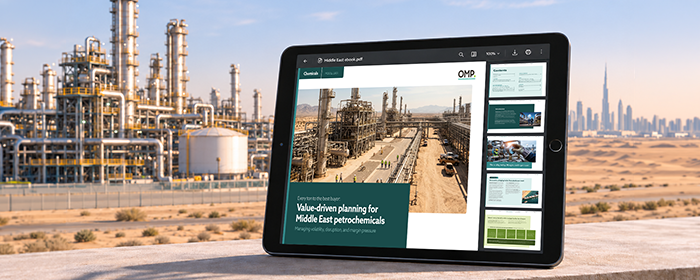
Value-driven planning steers each product to the market and buyer with the best margin, inside plant and contract limits. A weekly scenario routine replaces the one-time hunt for better markets, so the plan keeps pace with the market. The e-book shows how petrochemical supply chain planning in the Middle East can run on that weekly routine.
What's inside the e-book
- Why margins stay under pressure in the Middle East although chemical demand has grown
- How a digital twin puts plant, contract, and market limits in one model for chemicals producers
- How weekly what-if scenarios show which buyer earns the next ton
- Why UnisonIQ, the AI framework inside Unison Planning™, speeds decisions while planners stay in control
- How alliance partners and local data hosting support delivery, data residency, and workforce localization
Global producers already plan this way
BASF's petrochemicals division is rolling out Unison Planning™ for Chemicals globally. Evonik Oxeno moved from spreadsheets to a unified platform and now runs hundreds of what-if scenarios every week, where it once ran a handful per month.
How Unison Planning™ for Chemicals works
Unison Planning™ for Chemicals is OMP's platform for chemical planning. It builds a digital twin of plants, contracts, and markets, then compares scenarios against margin and sustainability targets. UnisonIQ, the AI framework inside Unison Planning™, adds AI engines, Unison Companion, and always-on agents that watch for change and propose actions while planners stay in control.
In the region, OMP's alliance partners in Egypt, Saudi Arabia, and the United Arab Emirates deliver locally, and OMP is joining Microsoft as a strategic partner in Saudi Arabia, with data hosted locally.
Get the Middle East petrochemicals e-book