Inventory optimization made easy
Put inventory where it creates the most value. Single and multi-echelon inventory optimization (MEIO), embedded in the Unison Planning™ unified model, so inventory decisions respect shelf life, co-products, and real production constraints. Explainable AI powered by UnisonIQ.
AI-powered recommendations turn business drivers into decisions faster: understand what's changing, get a ranked recommendation, and act, in less time than a manual review takes today.

)
More inventory is not the answer; smarter inventory is.
Most organizations carry more inventory than they need and still miss service targets. The problem is often not how much you hold. It is where you hold it, and how inventory placement decisions get made.
Inventory trapped in the wrong place
Safety stock set by rule of thumb creates costly buffers in the wrong locations. Excess and shortage coexist across the network. Working capital sits locked up while critical nodes still run dry.Static policies in a dynamic world
Supply chains are inherently stochastic. Demand varies, lead times are uncertain, disruptions are unpredictable. Fixed reorder points and deterministic calculations optimize for a world that does not exist, and they cannot adapt when conditions change.Plans that look right but cannot execute
Standalone inventory tools generate targets in isolation, disconnected from production capacity and scheduling reality. An inventory target that ignores what the plant can build is not an optimization. It is a new problem.Inventory decisions your supply chain can execute
Unison Inventory Optimization software is embedded directly in the unified planning model, not bolted on as a standalone module. Which means no tedious data transfers between systems. Inventory decisions are co-optimized with real production constraints, shelf-life requirements, storage limits, contractual obligations, and live demand signals, so the plan reflects what customers are actually buying, not a static forecast, all at once.
The result: no manual reconciliation, no conflicting signals between systems, no theoretical optimum the plant cannot build to. Inventory targets that are executable from day one, so you free working capital without sacrificing service.
One unified model. Every constraint. Executable from day one.
Four integrated capabilities. The full scope of process industry inventory decisions.
Start where you are. Scale when you're ready.
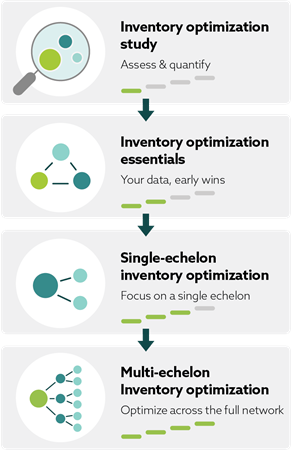
No need to optimize the whole network at once. Start with one product group, market, or region, prove the value, then expand, with confidence and momentum building at every step.
Inventory optimization study
Analysis and prototyping to determine scope and quantify value before full deployment. One-time inventory optimization with data quality and completeness assessment.
Inventory optimization essentials
A streamlined entry point for inventory optimization software so you gain early benefits with the data you have.
Single-echelon inventory optimization
Single-echelon inventory optimization for less interdependent network structures.
Multi-echelon inventory optimization
Full multi-echelon optimization for complex, multi-tier supply networks.
Built for process industries, not adapted to them
 |
 |
 |
 |
Process industry complexity is our baseline
Shelf-life constraints, co-product flows, regulated product handling, storage limits, diverging and converging networks. These are built into the platform's planning logic, not worked around it. Unison Planning™ handles multi-archetype environments, batch, continuous, and discrete together, that generic tools treat as edge cases.
Decisions the plant can actually build
Inventory optimization does not run beside planning. It runs inside the same model connected digital twin, the model as demand, supply, and production. Every target respects real capacity, shelf life, co-product flows, and storage limits at the moment it is set, so there is no reconciliation gap between the target and what the plant can produce.
Optimized for uncertainty, not around it
Unison Planning’s MEIO algorithms model demand and supply variability as stochastic inputs, not deterministic assumptions. The solver accounts for real-world uncertainty across the full network at once, producing inventory policies built for the world as it behaves.
UnisonIQ AI turns optimization into decisions people can act on
The hard part of inventory optimization is not the number. It is trusting the math behind the number enough to act, then acting on it. UnisonIQ AI decision agents make every inventory target transparent and executable inside the same model that produces it with no more black box calculations. So explanation and action are never separated from the plan.
Every target, explained
UnisonIQ’s generative AI, Companion, documents the data and logic behind every inventory target and explains the root cause whenever a target changes. Planners see why, not just what.
From alert to action
Rather than surfacing exceptions and leaving the work to the planner, UnisonIQ proposes ranked alternative strategies, quantifies the trade-offs, and automates approved policy updates. What needs attention arrives with a recommended action already formed. A recommendation to cut inventory by double digits can be uncomfortable to act on at face value. This is where confidence comes from: every recommendation is grounded in the same demand, supply, production, and distribution context as the rest of the plan, so planners and supply chain leaders can reduce or realign inventory with evidence behind the call, not just a number.
Confidence to commit
Because the AI leverages the same unified model that holds every constraint, its recommendations are always executable. Planners commit with confidence instead of second-guessing a black box.