How elite supply chains make critical decisions in minutes, not weeks
Lachelle Buchanan - March 3
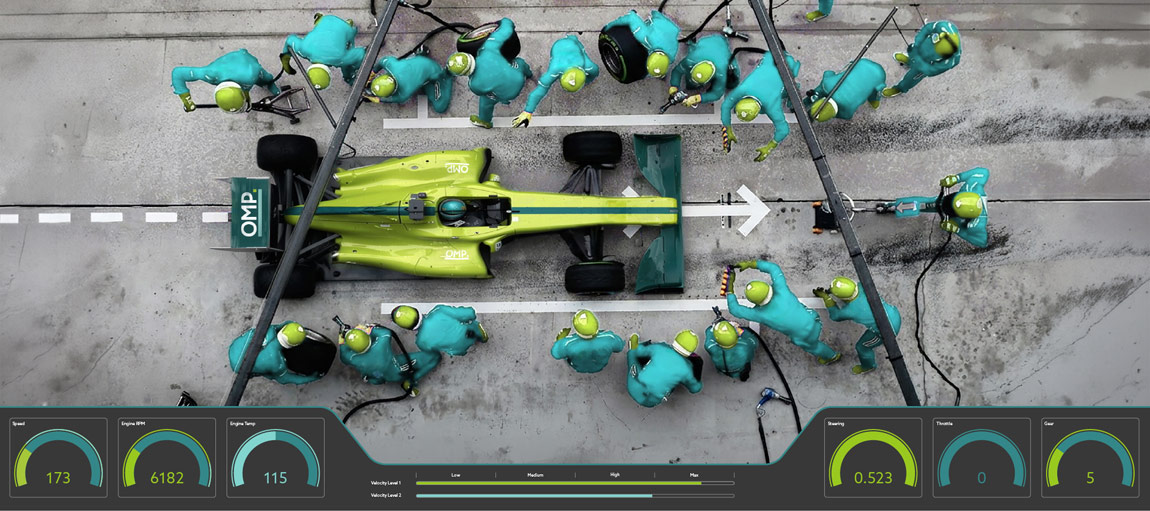
In Formula 1, races are won in seconds. Pit crews train relentlessly for every possible scenario so that when the moment comes, there is no hesitation. The decision has already been prepared.
Supply chains now operate under the same pressure. Regulatory changes, geopolitical shocks, demand spikes, and supply disruptions unfold in hours. Yet many organizations still rely on planning cycles designed for a slower world.
The speed gap costing you millions
The result is a widening speed gap. Markets move instantly. Decisions wait for the next meeting. Value erodes in between. For CSCOs, this creates a clear mandate: increase decision velocity without compromising decision quality.
”How to increase decision velocity without compromising decision quality?”
Decision velocity determines how quickly an organization can sense, decide, and act. Decision quality ensures those choices protect margin, safeguard service levels, and reinforce strategic priorities.
Mastering both through decision-centric planning powered by always-on decision intelligence is becoming the defining capability of high-performing supply chains.
Why traditional planning falls behind
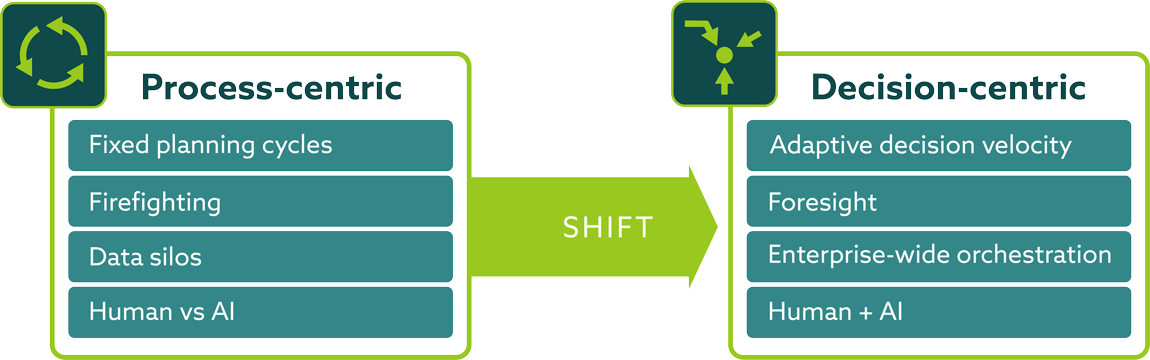
S&OP was revolutionary in the 1980s. It created structure, alignment, and discipline. But it was built on one assumption: decisions can wait until the next cycle. Today, that assumption no longer holds.
”S&OP was built on one assumption: decisions can wait until the next cycle.”
When disruption strikes between meetings, alignment slows. Emergency calls multiply. Decisions become reactive. Leaders spend time reconciling numbers instead of steering the business. Organizational latency expands.
As the Spark Initiative research shows, traditional processes, optimized for a steady state, simply can’t keep pace with markets that move in real time.
According to Gartner, organizations with dynamic decision processes are 4.9 times more likely to positively impact revenue during uncertainty. The differentiator is not data volume. It is converting signals into coordinated action before competitors do.
Structure alone does not create agility. Data-rich does not mean decision-ready. To close the gap, planning must evolve from calendar-driven processes to event-driven systems that operate continuously.
Decision-centric planning: start with the decision
Decision-centric planning flips the traditional paradigm. Instead of processes dictating how and when decisions are made, it starts with the decisions that matter and builds the planning model around them.
Two metrics that separate winners from laggards
1. Decision velocity
Decision velocity accelerates on two fronts:
Blog post

- Environment monitoring: Outside-in signals (POS data, buyer intent, weather patterns, supply disruptions) dramatically reduce latency by detecting changes the moment they happen.
- Organizational efficiency: Signals flow through an integrated, decision-driven model rather than slow sequential processes. Together, these mechanisms enable autonomous agents to execute routine decisions in seconds, escalating only when human judgment is needed.
Blog post
The result is a supply chain where critical decisions are made in minutes rather than weeks. Leadership attention shifts from firefighting to shaping long-term performance.
2. Decision quality
Blog post

Speed only drives competitive advantage when it’s aligned with strategy. Without alignment, it leads to chaos.
High-quality decisions require clarity on strategic priorities, KPI thresholds, and explicit trade-off logic across cost, service, sustainability, and resilience.
Blog post
Events trigger decisions based on predefined thresholds, and AI simulates scenarios, quantifies trade-offs, and surfaces implications before human debate begins.
The outcome is consistency under pressure. Margin protection and service reliability become systematic and reliable in every situation.
The three pillars of always-on decision intelligence
These pillars operate as a unified system rather than as isolated planning stages.
1. Strategy: define what “good” looks like
Strategic codifies priorities, decision policies, and KPI thresholds. A clear decision inventory defines which choices matter most, who owns them, and what constitutes acceptable trade-offs.
AI can reveal patterns and tensions, but governance defines the guardrails. Leadership sets the intent to ensure decisions consistently align with strategy.
2. Preparation: build scenario readiness
Blog post
Preparation begins by creating a complete view of the world with live data streams, including POS signals, buyer intent, weather patterns, macro indicators, and upstream supply insights. Causal models link these signals to potential business impacts. This makes the supply chain truly always-on: not just reacting faster, but anticipating disruptions.
With this, organizations simulate critical events in advance. AI then amplifies this work by generating event signatures, estimating impacts, recommending thresholds, and surfacing pre-tested response options. Planners can move with confidence and speed. Preparation transforms volatility into structured readiness.
Blog post
”When disruption occurs, leaders choose between prepared options, not reacting from scratch.”
3. Execution: trigger event-driven workflows
Blog post
When real-world signals match a critical event signature, the system triggers a decision workflow:
- AI detects the disruption.
- Predictive models assess impact across the network.
- Decision workflows guide the appropriate stakeholders.
- Decisions are executed or escalated immediately.
Continuous learning refines criteria, workflows, and recommendations over time, strengthening both speed and confidence. Recurring decisions can be partially or fully automated, always with transparency and human oversight.

Blog post
”The outcome isn’t simply faster reaction, but controlled anticipation at scale.”
Why supply chain-specific intelligence matters
Generic decision intelligence platforms promise flexibility, broad applicability, and reusable logic. They sound appealing in theory, but supply chain decisions are anything but generic. They are deeply contextual, interconnected, and constrained by capacity, lead times, network dependencies, contractual commitments, and margin structures.
A decision to expedite a shipment is more than just a cost trade-off. It affects production stability, inventory positioning, sustainability targets, and customer commitments all at once.
Decision-centric planning must therefore be grounded in supply chain intelligence. Otherwise, speed increases while coherence deteriorates.
Enhancing, not replacing S&OP
”Decision-centric planning doesn’t eliminate S&OP. It strengthens it.”
S&OP remains essential for strategic alignment and long-term direction. Decision-centric planning embeds that strategic intent into continuous execution across the organization.
Blog post
Rather than concentrating decision authority in fixed calendar meetings, readiness flows throughout the operating model. Strategy is applied continuously and executed proactively. It is encoded into criteria, scenarios, and workflows that operate without pause.
The result is more than a bridge between meetings. It is a structurally more resilient planning system that ensures strategy is applied consistently, at speed, and under pressure.
Organizations that move first don’t wait for volatility to stabilize. They redesign how decisions are made.

Blog post
Supply chain leaders, take action
Volatility is structural, not cyclical. The question is no longer whether disruptions will occur. The real test is whether your decision system can respond at the speed of impact.
Organizations that master decision velocity and quality protect margin, preserve service, and turn uncertainty into competitive advantage. Those relying on fixed cycles risk reacting after revenue, margin, and customer trust have already been compromised.
”In the always-on supply chain, speed and alignment move together. The outcome is decided long before the moment arrives.”
Decision-centric planning embeds strategy into every workflow, anticipates disruptions, and ensures fast, coordinated action when seconds matter. Redesign how your organization makes its most critical supply chain decisions today.

Lachelle Buchanan
Product Marketing Manager
Biography
With deep expertise in S&OP, digital transformation, and B2B SaaS, Lachelle is an executive leader in supply chain and product marketing. She drives global planning and commercialization, writing on AI, data-driven decisions, and building resilient, future-ready operations.