See the menu before you sit down: plan supply chain decisions ahead of disruption
Christian Wöllenstein - April 22

What if supply chain leaders could make faster, better decisions, not by reacting quicker, but by preparing smarter?
Decision-centric planning reframes the purpose of planning. Instead of trying to produce a perfect forecast, it equips teams with the insight and optionality to make confident, timely decisions.
”Proactive supply chain planning means understanding possible futures before they arrive, so when change hits, you’re ready to act. ”
Like checking a restaurant menu before you walk in, preparation changes the decision process entirely.
Preparation beats reaction
Imagine walking into a new restaurant. You open the menu just as the server appears to take your order, and suddenly you’re overwhelmed. You hesitate, compare, and rethink. Decision-making slows just when you need it most.
Now imagine a different scenario. Before leaving home, you check the restaurant’s menu online. You already know the options and what you’d love to eat. So when the waiter arrives, you order confidently and quickly. If your first choice is unavailable, you immediately pivot to your second-best option. Or you decide to go somewhere else entirely after checking the menu and reviews online.
Now scale that moment to large organizations, where decisions are rarely made alone. Multiple stakeholders, functions, and priorities all need to align. Reaching consensus on the “best meal” becomes chaos if no one has seen the menu beforehand. Without preparation, speed rarely leads to good decisions.
This is exactly the difference between reactive planning and proactive, decision-centric planning. It gives you clarity on your choices and alignment around them, long before you’re forced to
make the call.
Why reactive planning fails in modern supply chains
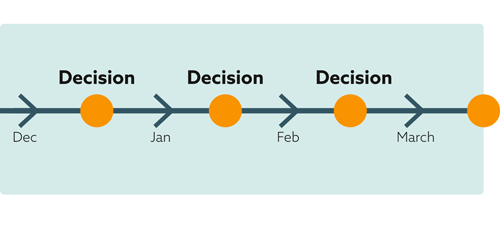
Traditional supply chain planning is largely reactive. A disruption happens, data arrives, analysis begins, and only then does decision-making start.
Blog post
In the current volatile environment, this approach is risky:
- Velocity matters more than ever. Markets move fast, disruptions unfold in real time, and delays can quickly cascade across the network.
- Margins are shrinking and competition is fierce. There is less room for error. Slow or inefficient decisions directly impact profitability and competitiveness.
- Complexity is growing. Global networks, geopolitical shifts, and climate impacts make “wait and see” an expensive strategy. Decisions get rushed, often without proper analysis.
Blog post
Simply reacting is often too slow and too late. Decision-centric planning solves this by shifting the focus from reacting to events to preparing for decisions you may need to make.
How decision-centric planning accelerates decision velocity
Proactive supply chain planning shifts the focus from reacting toward preparing for possibilities.
At its core, decision-centric planning requires end-to-end visibility into the future, not as a single forecast, but as a set of scenarios that illuminate the decisions you may need to make.
”The clearer the picture of possible futures, the easier it becomes to prepare those decisions ahead of time. ”
Blog post
Decision-centric scenario planning enables companies to:
- Anticipate what might happen before it does
- Pre-define decision options and response strategies
- Switch plans quickly when reality deviates from expectations
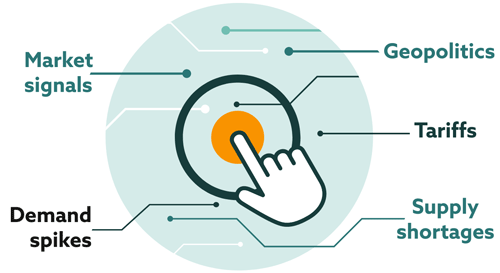
Think about a scenario where climate change causes a river that’s critical for transportation or cooling to dry up. If this risk is anticipated early, organizations can explore alternatives, test contingencies, and align stakeholders before it hits. When the event actually occurs, the response is no longer improvised, but simply executed.
Blog post
This is the essence of decision-centric planning. Instead of reacting in the heat of the moment with limited data or insight, decisions are prepared, validated, aligned collaboratively, and ready to execute.
Strategies for proactive supply chain planning
A decision-centric supply chain starts with awareness. Organizations cannot prepare decisions for futures they have never considered.
This requires staying close to the market and to the signals that may reshape it, from technology shifts and regulatory changes to competitor moves and external disruptions. When these signals appear, they should trigger structured scenario exploration. Which developments could materially affect the business? Which decisions might they force?
Each scenario then becomes a rehearsal for future decisions. What choices would need to be made? Which tradeoffs would shape the outcome? What options should already be prepared?
Over time, this expands optionality and strengthens decision readiness.
Business strategy drives the decision-centric enterprise
A proactive, decision-centric supply chain requires a clear understanding of where you stand today and how that position might change tomorrow. Business strategy sets the priorities that decision-centric planning must support. There are many business strategy frameworks, such as SWOT which helps illustrate how decision-centric planning connects to strategy:
- Drive to insight. Strengths and weaknesses help clarify what your organization is actually capable of executing when disruption hits. Opportunities and threats highlight where external change could amplify or erode your position, and what decisions may be required as a result.
- Connect strategy to execution. A scenario is only useful if you understand how it interacts with your strengths, exposes your weaknesses, and shapes the decisions you’ll need to make. SWOT becomes the bridge between strategic intent and operational decision pathways.
- Stress test assumptions. Insights are not only positive. Proactively exploring threats reveals vulnerabilities early, before they turn into costly surprises, and helps define the decisions you must prepare in advance.
Think in a cone of plausibility
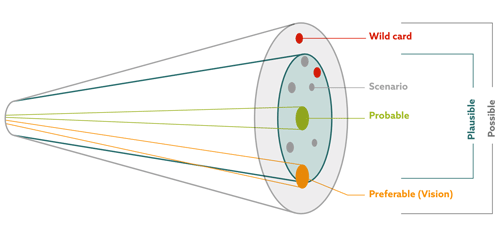
Decision-centric planning uses the cone of plausibility as a practical way to structure thinking and focus on the decisions that require preparation.
Blog post
Instead of treating all futures equally, scenarios are evaluated along four dimensions:
- Preferable: Futures you would like to achieve and can actively work toward
- Possible: Futures that could happen under the right conditions
- Plausible: Futures that make sense given current knowledge and trends
- Probable: Futures that are most likely to occur
Blog post
This framework helps teams avoid two common pitfalls: planning only for the most likely future, or spreading effort too thin across unlikely extremes. In a decision-centric context, the cone becomes a way to map which decisions need to be prepared now, which need monitoring, and which shape long-term strategic direction.
In practice, organizations can:
- Focus detailed decision preparation on plausible and probable scenarios
- Use preferable scenarios to guide long-term strategy and investment choices
- Keep possible but unlikely scenarios on the radar as early-warning signals that trigger predefined decision pathways
This structured approach enables preparedness without overengineering the planning process and keeps the emphasis on decision readiness, not exhaustive modeling.
- You cannot model everything, and you shouldn’t try. Decision-centric planning recognizes that the goal is not perfection, but preparedness. The value lies in identifying the scenarios and decisions that truly shape outcomes.
By focusing on the high-impact decisions, where trade‑offs are significant, risks are meaningful, and timing is critical, organizations avoid analysis paralysis. Instead, they build a planning discipline that is both practical and powerful.
Executives don’t need more data. They need clearer insight to make faster decisions with less risk. Decision-centric planning transforms planning from a rearward-looking reporting exercise into a forward-looking decision advantage.
Discover how decision-centric planning helps organizations anticipate disruption, evaluate scenarios, and act faster.

Christian Wöllenstein
Senior Project Manager
Biography
With more than a decade as a project manager in the chemical industry, Christian was an early adopter of decision-centric planning. He is passionate about integrating classical planning with decision-making within Unison Planning, empowering OMP customers to make high-quality decisions with greater velocity.