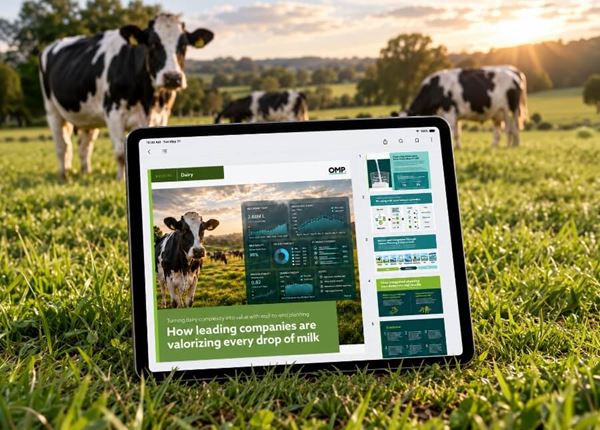
How leading companies are valorizing every drop of milk
eBook
Why do dairy supply chain planning break down?
The tanker arrives. The volume is logged, the composition is tested, and the plan for the week was built on neither. Raw milk shifts with season, weather, feed, and herd health, and it starts losing value the moment it leaves the farm. There is no buffer to absorb the gap, because the product that would hold it expires.
So the decision gets made function by function. Cheese decides its run, and whey and cream inherit the consequence. Drying capacity is committed before anyone knows what the fat-to-protein ratio will support. Each answer is defensible on its own, and together they route milk into the stream that clears volume rather than the one that carries margin.
None of it registers as a single failure, which is why it persists. It shows up as write-offs at the end of shelf life, stockouts on the products that were worth making, and loads dumped because nothing downstream could take them. The cost is real and permanently unattributed.
eBook
Milk allocation planning: the decision the whole plan turns on
Treat allocation as the decision everything else follows, and make it with the full chain in view. Sourcing, processing, shelf life, and demand sit in one model, so a planner can see what an option does to margin before committing to it, not after the milk has moved.
What's inside the e-book
- Why continuous, variable milk supply breaks conventional planning logic
- How to allocate milk components to the highest-value product streams
- How to build shelf-life limits into the plan instead of policing them after the fact
- Why interdependent by-products need network optimization, not product optimization
- What dairy processors and cooperatives report after connecting sourcing, production, and demand
Proven in dairy processing
Dairy processors and cooperatives, such as Land O’Lakes or FrieslandCampina, are already planning this way, and report improvements in margin, service, and waste.
How Unison Planning™ for Dairy works
The e-book shows how OMP's Unison Planning™ for Dairy plans milk sourcing, production, shelf life, and demand in one model. Dynamic bills of material recalculate how variable milk should be processed to meet fixed product specifications, so the plan absorbs composition changes instead of breaking on them.
A dairy-specific digital twin carries the constraints that actually bind, which keeps the resulting plans executable on the plant floor rather than credible only on paper.