
Beyond accuracy: Why clean master data isn't the whole story
Jonathan Dalle and Jan Geuens - September 2

When master data "looks fine," that's exactly when you should look closer
Every planning team knows the rule: garbage in, garbage out. If your master data is wrong, your supply plan will be wrong too. That’s why planning departments are increasingly calibrating their master data against “actuals” (the real historical data coming out of manufacturing, logistics, and transactional systems) to keep numbers honest.
But here's the trap. When master data accuracy becomes the main KPI you're chasing, it's easy to declare victory the moment the averages look good, and walk straight past the real problem hiding underneath: an accurate number can still describe an unhealthy operation.
The plant where the numbers said everything was fine
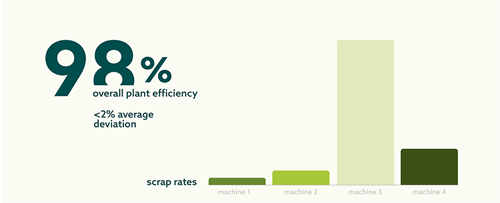
We recently worked with an OMP customer whose master data looked, by every standard measure, solid. Across all machines in the plant, the average deviation between actuals and planning master data sat under 2 percent. On paper, that's a clean bill of health.
Most master data programs would have stopped there.
”But accuracy answers exactly one question: does the master data match what happens on the floor?”
It never asks whether what happens is any good. Using Unison Planning's Data Genie functionality, we asked the second question, benchmarking machines against each other rather than each against its own history, and found that a handful of machines were scrapping at rates several times higher than comparable machines running the same products. Their master data was not wrong. It faithfully recorded scrap that nobody had ever questioned, hiding an inefficiency that had gone unnoticed for a considerable period.
Blog post
”That's the core issue with accuracy-based master data analysis: an accuracy score is a summary, not a diagnosis. It can tell you that things are broadly fine while masking exactly where they aren't.”
Alongside statistical analysis, Data Genie performs ML-based cross-machine analysis and benchmarking, comparing performance across machines and runs rather than collapsing everything into a single number. That's what makes it possible to catch the anomalies and negative trends that no accuracy check would flag.
Blog post
A second case: when "high waste" wasn't really about waste
A different OMP customer ran into a related version of this problem last year. Their actuals showed high average waste values for certain products. The instinctive fix: increase production volume per run by a few percentage points to compensate.
It seemed reasonable.
A closer look at the actuals through Data Genie told a different story. Most production runs weren't wasteful at all. The real issue was that roughly one in every twenty runs failed completely, generating 100 percent waste. The "high average waste" was an artifact of these total failures dragging the number up, not a sign of broad inefficiency across every run.
Increasing production volume didn't address the root cause. It just let the failed runs slip by, absorbed into a bigger batch, unnoticed and unfixed.
Following the thread to the actual root cause
With the real pattern in view, we recommended a closer examination of the production process itself. That investigation traced the failed runs back to variation in raw materials.
Armed with that insight, the customer implemented additional raw material quality checks. Failed runs largely stopped, and the result was significant annual cost savings
From clean data to a continuously improving supply chain
Both stories point to the same lesson. Master data accuracy is necessary, but it isn't sufficient on its own. The real value comes from what you do with the data once it's accurate: digging into the actuals behind machine rates, yields, lead times, and other critical parameters to find the subtle anomalies that averages conceal.
That kind of scrutiny shouldn't be a one-off exercise. It works best as part of a broader, long-term improvement program, where master data review is a recurring discipline rather than a box to check once and forget.
Want to get more value from your supply chain? Explore how better data can uncover hidden inefficiencies and improve planning decisions.

Jonathan Dalle
Presales Architect at OMP USA
Biography
Being primarily involved in the early stages of projects, Jonathan enjoys collaborating closely with customers to shape a supply chain planning solution that meets their current needs and future aspirations.
Jan Geuens
Partner at OMP BE
Biography
25 years at OMP leading supply chain implementations in the mill products industry mean that Jan is the go-to guy on program roll-out, worldwide. His special focus is now on helping companies achieve their sustainability aims through smarter planning.